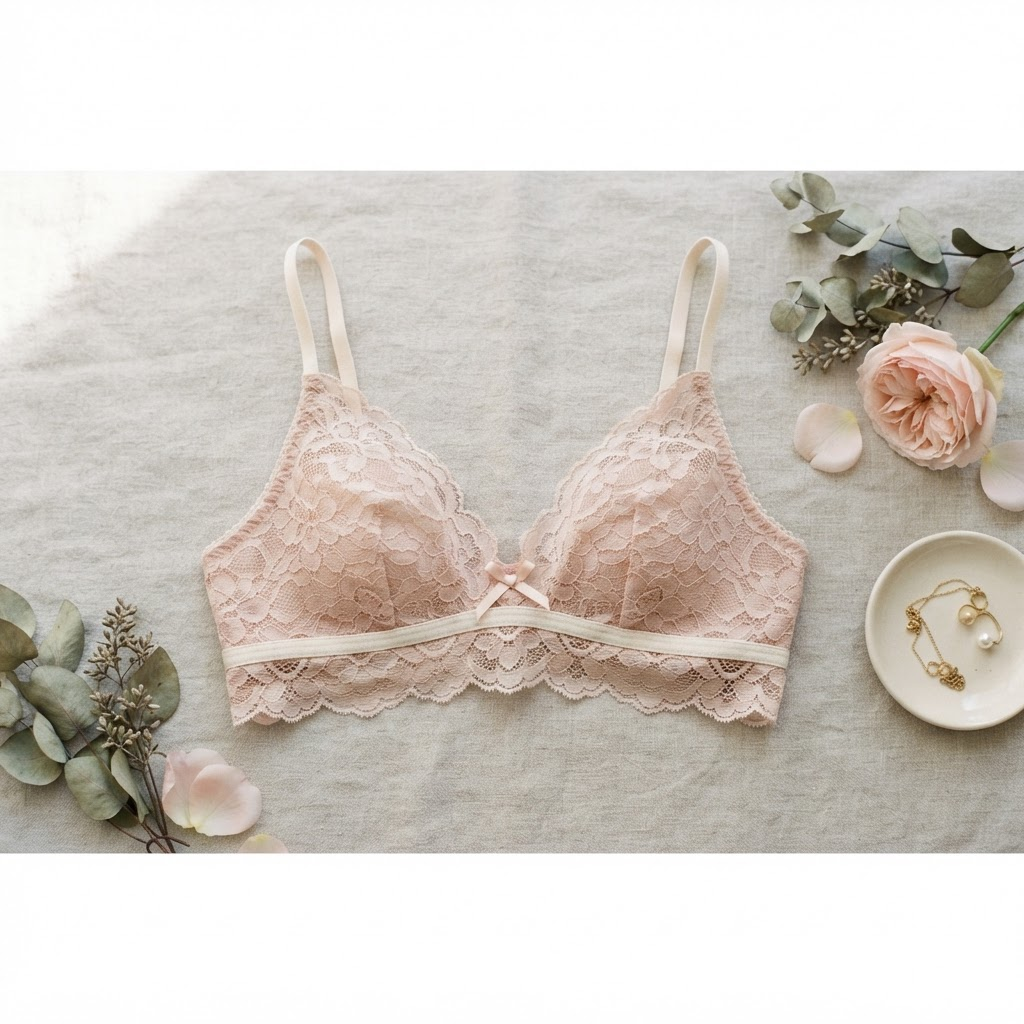
From the whalebone corset to the wireless bralette: how a length of pink ribbon and two handkerchiefs, tied together on the eve of a debutante ball in 1910, grew into one of the most engineered — and most contested — garments a person can own.
Each section stands on its own — dip into the invention story, the mechanics of the garment itself, a century of changing silhouettes, or the moments the bra made headlines.

From 19th-century corsetry to Mary Phelps Jacob's 1914 patent and beyond — the invention story, decade by decade.
Read the history →
Band, gore, cup, underwire, strap — a labeled breakdown of what actually makes a bra work.
See the diagram →
Flat flapper bandeaus, bullet bras, T-shirt bras, bralettes — how the common silhouette shifted every ten years.
Browse the decades →
The "bra-burning" myth, Madonna's cone bra, Wonderbra's "Hello Boys," and the rise of the bralette.
See the moments →Women wore some form of bust support — strips of cloth, corset covers, "bust improvers" — for centuries before the word "brassiere" entered the Oxford English Dictionary in 1911. The modern two-cup bra as most people would recognize it took shape between the 1870s and the 1930s, through the work of designers like Herminie Cadolle in Paris and, most famously, a 19-year-old New York socialite named Mary Phelps Jacob, who improvised one from two handkerchiefs and a ribbon rather than wear a whalebone corset under a sheer gown.
Every decade since has added something: adjustable straps and underwire in the 1920s, standardized cup sizing in the 1930s, elastic and spandex in the 1950s, the sports bra in 1977, molded T-shirt cups in the 1990s. The result is a garment with a surprisingly deep engineering history — and an equally deep cultural one.
Read the full timeline →
1898 corset advertisement, Ladies' Home Journal — the era the bra was invented to replace.